Showing posts with label SUBJ Werewolves. Show all posts

Thursday, June 11, 2009

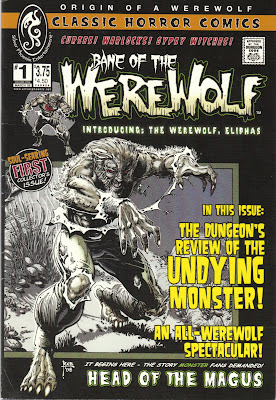
Werewolf comics

And Now the Screaming Starts has a cool review of what sounds to me like a fun, cool werewolf comic. Unfortunately, I checked with three local comic shops yesterday and not a one of them was carrying it. I would have checked a fourth, but the douchebags are never open during hours when I can actually get there, so fuck 'em. Which leaves me with what options, exactly? For a single floppy, I don't feel like shelling out for shipping (and handling!) on top of an already high price. I guess I'll just hope for a trade collection.

That brings me, reluctantly, to this:

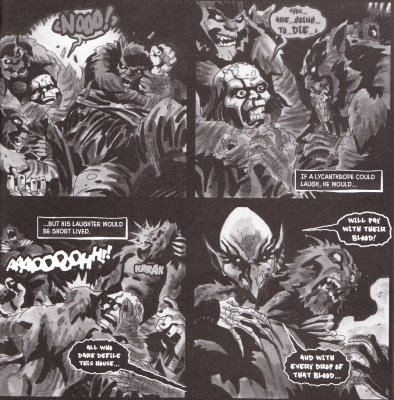
Looks awesome, doesn't it? Well, some things about it are pretty sweet, but overall I found it kind of disappointing.

I have to confess, my reaction is almost certainly colored by the screwups and delays in processing and shipping my order. This is the notorious Exhibit B, and there were more problems after that. The guy finally sent me a copy (a second copy, if he really sent out a first one like he said) via priority mail with delivery confirmation, and a number of bonus comics thrown in for good measure. To be fair, considering that I only paid 3.99 via paypal, he did make sure I got it at quite a bit of expense to himself, and also tried to make amends, at further expense to himself. I feel a little uncharitable airing this here, since he did go to all that trouble in the end, but the point is that he needn't have gone to any of it if he'd just gotten things right the first or even the second time. After all that drama and hassle, it's hard not to look at this comic and ask myself, Was it worth all that?!?

Meh. I'll say this--writer/artist Rob E. Brown gets all the big, general stuff exactly right. Story-wise, he packs the pages with gypsies, castles, forests, and monsters who square off in savage combat. Art-wise, his detailed black-and-white work is, at first glance, gloriously reminiscent of Warren and Skywald mags from the groovy age.

His storytelling isn't so hot, though. This is an incredibly wordy comic; at times it crosses the line to illustrated text. And yet for all those words, I seldom got a very clear sense of who the characters were or how events connected. As for the art, all the detail seemed to get in the way sometimes. I'd echo this reviewer's complaint: "While the emotions of the scenes are depicted well I feel the inking was overdone. I did have to really look at some panels to know what was going on." At that link, you can also have a look at some sample pages--see more also at this interview with Brown and this "Making of" page. Here are a few sample pages for the next issue. Brown says the plan is to collect each miniseries-arc as a trade, and I think I'll just wait for that. Classic gothic monster completist that I am, I can't just skip these altogether, but ordering single issues really doesn't seem like the way to go for me.

Tuesday, November 04, 2008

MONSTER RALLY, Pt. 3: Comics


Previously:
As inevitable as it was that monsters should find their way into comics, so it was inevitable they'd meet each other in comic book monster rallies.

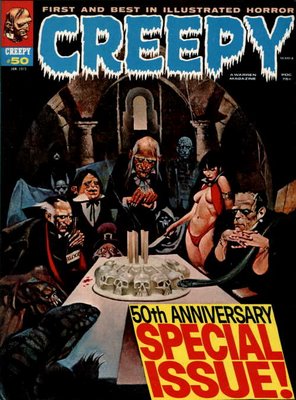
In anthology-style horror comics, filling the pages with various monsters issue after issue would result in the "virtual monster rally" effect I mentioned with Universal. The pages between the lurid covers would meld together in the mind to become a continuous horrorscape populated with all kinds of monsters who could wander into each other, in theory and in dreams if not in any actual story. The Creepy cover above perfectly expresses this dynamic, gathering Warren's signature horror icons and various other creatures in ghoulish celebration of a magazine milestone.

In episodic, ongoing series about particular monsters, meetings and battles with other monsters are an obvious and reliable device for story ideas and keeping things lively. Thus, Dick Briefer's Frankenstein crossed paths with a wide assortment of monsters and beasties on a fairly regular basis. Warren's Vampirella faced off against, among other things, Dracula, a werewolf, and a mummy.

In 1971, the Comics Code Authority, which had put the kibosh on horror comics by design since its inception, relaxed somewhat to permit certain kinds of horror:
Scenes dealing with, or instruments associated with walking dead, or torture, shall not be used. Vampires, ghouls and werewolves shall be permitted when handled in the classic tradition such as Frankenstein, Dracula, and other high calibre literary works written by Edgar Allan Poe, Saki, Conan Doyle and other respected authors whose works are read in schools around the world.
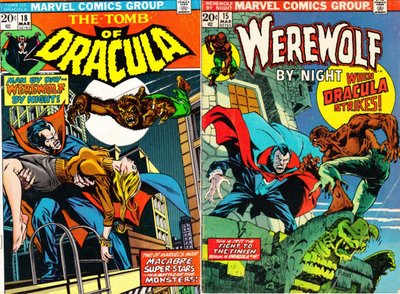
Marvel famously exploded through that crack in the dam to flood the field with monsters, monsters, monsters, and more monsters. They launched standard color comics like Tomb of Dracula, Werewolf by Night, Monster of Frankenstein (later Frankenstein Monster), Supernatural Thrillers (which became, for all practical purposes Living Mummy), Adventure Into Fear (which introduced Man Thing and later became, essentially, Morbius the Living Vampire) and plenty others, and a complementary full-court press of Warren-style black and white magazines that could nose into edgier territory and give the remaining CCA constraints a big "fuck-you!" by emblazoning Tales of the ZOMBIE across the masthead of one title.

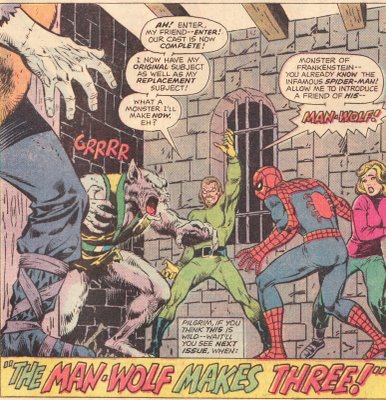
With a raft of monsters starring in their own titles, obviously modeled on Universal's stable of icons, and guest-appearance crossovers already a well-established trope in the superhero comics, it was only a matter of time before Marvel unleashed them against each other and let the mashing commence. These encounters are truly wonderful to behold. The Code imposed on them an innocence charmingly reminiscent of the Universal classics, but unlike the Universal monster rallies, real brawling happened and fur really flew. They unfolded in four-color glory almost like superhero donnybrooks, and in fact, Spider Man found himself caught in the middle of a number of them.

God only knows how many issues there are in Marvel's bronze age horror run--does anyone know of an exhaustive index online?--but I consider it one of the most extensive and important treasure troves bequeathed to us from the Groovy Age of Horror, and these occasional monster crossovers are among the crown jewels of it all.

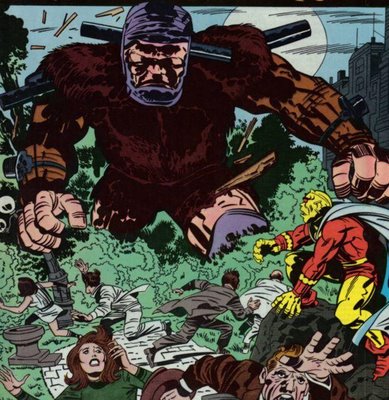
The Distinguished Competition, meanwhile, joined the fun full-throttle with the legendary opening issues of Wein and Wrightson's Swamp Thing (collected in the Dark Genesis graphic novel--worth its weight in gold!), which pit the eponymous creature against twisted and terrifying versions of horror icons like the Frankenstein Monster and the werewolf in quick succession. And then there's Kirby's supernatural hero the Demon, who faced off against a ridiculously awesome Kirby Frankenstein Monster.

So far, we've mainly been considering monster mashups that occurred as episodes in ongoing horror comic book series. But there are also graphic novels devoted to monster rallies as standalone stories.

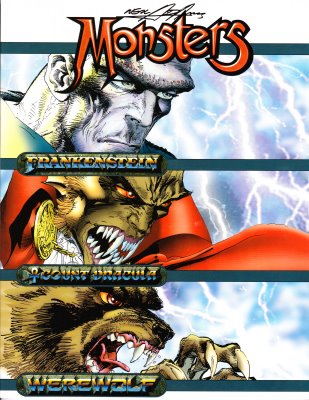
Neal Adams recounts, in his Introduction to the Monsters graphic novel (created, written, and drawn by him), how as a child he both loved the Universals and felt dissatisfied with them:
When I was a kid, probably like most of you, I loved monsters. All I could think of when monsters reared their ugly heads was 1. how terrified I was and 2. how I'd do it better. Finally I thought, simply, how I'd create them if I had the chance.

When Universal did the Frankenstein, Dracula, and Wolfman movies, I'd always felt they'd missed the boat. They didn't do the one final movie. You know, the one where the monsters all battle.
He presents Monsters as the fulfillment of that dream of doing a monster rally right. I hate to say, it doesn't come off as quite the personal project he suggests it is, and certainly not as the monster rally that finally gets it all right. I'd have to concur with Adrian Salmon's informal remarks about it, which also supply some interesting historical details:
i have actually read the story you are talking about - it was reprinted here in the mid 70's in house of hammer magazine and *caused* outrage in the letters page as it was used as a fill in instead of the usual hammer comic adaptions.

overall and i'm going from memory here - i thought it was a decent *professional* job and nothing more. adams' style is very advertising oriented - very clinical at times and i got that *job for a client* feel from it. I'm surprised he classes this as a labour of love actually - it has little real soul and i thought dracula particularly unimpressive and his sideburns made me confuse him with the wolfman sometimes.
Monsters do tussle in Monsters, but as Salmon says, there's something oddly detached and unsatisfying about it.

That brings us to Black Forest, written by Todd Livingston and Robert Tinnell, and drawn by Neil Vokes. It hit shelves in 2004, the same year that saw the release of the Dracula, Frankenstein, and Wolf Man Legacy Collections on dvd, and the release of Universal's long-awaited and excruciatingly disappointing monster rally revival Van Helsing in theaters.

Basically, Black Forest is what Adams' Monsters pretends to be--the one that gets it right. I go into this in detail in my extended review, posted over at Cinema Nocturna. Full disclosure: Tinnell and Vokes are personal pals of mine, but if you want a more objective measure of their achievement, just check out how handily they won the Classic Horror Film Board's 2004 Rondo Award for Best Horror Comic.

And that's my take on monster rallies in horror comics--overall, mighty fun and engaging, with only a few less exciting examples that I'd still recommend as worth a look.

Friday, October 31, 2008

MONSTER RALLY, Pt. 2: Hammer

Previously:


Though Hammer launched their own colour versions of Dracula, Frankenstein, the werewolf, the mummy, assorted vampires, zombies, etc., they never produced a single monster rally. Who knows why? (Seriously--if anyone knows anything about this, from interviews or any source at all, please clue me in!) I consider it one of the great cinematic missed opportunities.

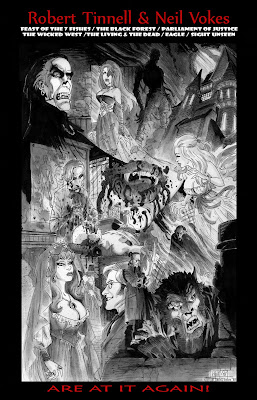
Fortunately, Bob Tinnell and Neil Vokes aim to rectify the situation with a Hammerific monster rally comic:
What we decided to do is, we wanted to approach the sensibilities of the '60s gothic horror and '70s gothic horror that Hammer were putting out. So we’re doing kind of a massive… In the way we did Black Forest, as if a studio like Hammer sat down and did a huge monster rally. So the story's born out of Carmilla. It starts with some lovely lesbian vampire scenes and it explodes from there to include Frankenstein, Count Dracula, a werewolf, a mummy… I mean it really - I’ve never had so much fun writing.
They've already worked their magic with a Universal-style monster rally graphic novel, Black Forest (more on that in a future post for this series!), so I'm really looking forward to this one. Here are interviews with Vokes and Tinnell about previous projects, to help you get a better feel of where they're coming from on this.

In the meantime, I've sketched out my own thoughts about how I'd like a Hammer monster rally to go. I originally posted it over at the now-defunct Horror Blog, but I'll repost it here, in the spirit of Halloween sharing:
Leon the werewolf has been revived by the removal of the silver bullet from his heart, and now, desperate to be cured of his lycanthropy, seeks out the notorious Baron Frankenstein as the only one who may be able to help him. Van Helsing, however, has picked up the trail of the werewolf, and now hunts him across Europe. Van Helsing, in turn, is hunted by the Circus of Nights. Enough of them survived their apparent destruction to restore most of the others-except Count Mitterhaus, whose decapitation can’t be undone as easily as, say, removing the stake from Emil’s heart. They believe Dracula can restore Mitterhaus, but they don’t know how to find him, except perhaps through Van Helsing.

Having followed Van Helsing (following the werewolf) into Frankenstein’s town, the Circus mistakenly nabs the Baron. They sit him down in front of the Mirror of Life, expecting it to open a portal to Dracula, since their fates are so entwined. Instead, EVERY Frankenstein Monster from the franchise comes charging out of the mirror. The werewolf shows up, having followed the Baron’s scent from his quarters, which were in disarray from the struggle he briefly put up when the Circus kidnapped him. So now we’ve got all the vampires from the Circus, all the Frankenstein Monsters, and the werewolf, all snarling and facing off in this hall of mirrors, which reflects the whole lot of them many times over. Pandemonium ensues.

Frankenstein takes the opportunity to make a run for it. Just when he thinks he’s found the exit instead of mirrors and more mirrors, he lunges, only to run smack into-HIMSELF!! Only it’s not; it’s Van Helsing. The two gape at each other for a heartbeat, then roughly shoulder past each other, Frankenstein fleeing for his life, and Van Helsing in hot pursuit of the werewolf. Van Helsing can’t believe his eyes when he sees the monster mash in progress. But now the Mirror of Life responds to him, and opens a scene on a graveyard in which Count Dracula bends over a girl in his arms and feeds from her throat. No matter how many monsters are present all around him, Drac is his oldest, bitterest foe. He shouts, “Dracula!” and tries to jump through the Mirror. One of the Frankenstein Monsters grabs him, though, mistaking him for its hated creator.

Anna the Gypsy woman rushes before the mirror and begs Dracula to restore Mitterhaus. Drac points at Van Helsing and says something to the effect of, “I will if you bring me his head!” She asks where he is, and he tells her he’ll be in his castle three nights hence.

Van Helsing has managed to free himself from the Frankenstein Monster, but now has become the focus of all the Monsters’ wrath, and also the focus of the vampires, as well, who now want his head. Only Leon, the werewolf he meant to destroy, battles to defend him, believing him to be the Baron who might be able to cure lycanthropy. Oh, and Karl, from Revenge of Frankenstein, joins their side, having retained his loyalty to Frankenstein and belief in him. Things get extraordinarily savage, to the point that even Van Helsing balks. He realizes he’s in over his head this time, and decides that discretion is the better part of valor. By now the Hall of Mirrors is a shambles, and a hole has been punched through a wall to the outside. Van Helsing jumps through it and flees, with the werewolf and the Monster Karl fighting to cover his escape.

He doesn’t get far, however-Frankenstein has stopped to observe from a distance, and clouts him over the head to knock him out. When he comes to in Frankenstein’s laboratory, they become acquainted in an increasingly tense exchange. Both are aware of each other’s reputations, and each puts a first foot forward that only confirms the other’s prejudice. Van Helsing regards Frankenstein as evil, and Frankenstein regards Van Helsing with ferocious contempt as the embodiment of all those who destroy what they cannot understand, who have plagued his entire life’s work.

Just as they’re about to come to blows, things really come to a head when Leon (now human) and Karl show up, battle-scarred and shell-shocked. Karl especially has been bitten and badly wounded. Van Helsing, of course, wants to destroy both of them at once, and Frankenstein absolutely won’t hear of it. Van Helsing points out that Karl will become a vampire soon if not destroyed. Frankenstein insists they try to save him. Practically begging, he appeals to Van Helsing as a man of medicine. That breaks through and snaps VH out of monster-hunter mode. With grave reservations, he agrees to help.

They set right to work, at first with much wrangling and debate, but with increasing cooperation and understanding of each other. Frank, of course, is the medical expert, far outstripping VH in that regard-as VH comes to realize with increasing awe. VH, though, brings his truly formidable knowledge of battling metaphysical evil to the table, and in the course of the operation Frank must acknowledge that it’s not all just a bunch of superstition. His experience of the vampires has actually shaken him more than he’d admitted to himself at first, and there’s now a crack in his icy amorality-which is why he wants to cure Karl of vampirism, instead of observing the effects of it on him, as he normally might be expected to do. Even he must recognize them as abominations deserving of destruction.

Thanks to their rapid and decisive intervention, Karl is cured, but the night isn’t over, and the last remaining members of the Circus assault the laboratory. Karl almost can’t bear to face them again, but Frankenstein urges courage. VH empathizes with Karl’s fear and is moved to pity, cementing his view of Karl as more human than a creation of evil. The battle is fierce, but the vampires go down one by one, until only Anna remains. She wants Van Helsing’s head, as per Dracula’s command, and in fact she lops it off, just before she’s dispatched with a well-aimed stake by Leon! Frankenstein doesn’t even hesitate. Despite his fatigue, cool as a cucumber, barking clipped orders at Karl and Leon, he sets about reattaching the head, essentially repaying the favor VH did him by helping cure Karl rather than destroying him.

So it’s morning now, and the Circus of Nights has been thoroughly eradicated. Leon and Karl report that the Frankenstein Monsters have all been killed in the previous fight (some were killed by vampires in the chaos before everything came to focus on Van Helsing). That leaves only Leon to be cured, and Dracula to be destroyed. Frank wants to cure Leon (partly, it must be admitted, out of curiosity and vanity), but recognizes that, as with curing Karl, he’ll need VH’s expertise to supplement his own. VH, though, now knows Dracula is returning to his castle, and wants to set right off to surprise him there. Karl, in better spirits after their victory, can’t stand the idea of anyone facing such powerful evil alone, and urges that they all go together to slay the Count.

These converging interests hold the group together, and so they depart together for Transylvania. On the journey, Frank and VH discuss how to cure Leon, and actually believe they hit on the solution. Leon realizes how impatient he is to be cured, and he also realizes that if any of them die in battle with Dracula, his one chance to be cured will be forever lost. He wants to be cured right away, but they agree that he’ll be more helpful in the coming fight as a werewolf.

That’s as far as I’ve spun it out.

Thursday, October 30, 2008

MONSTER RALLY, Pt. 1: The Universals

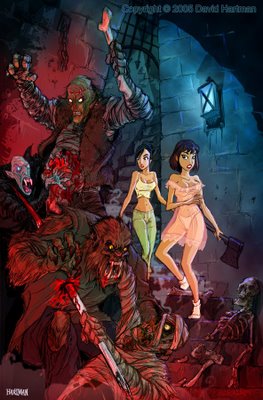
("Monster Mash" by David Hartman)

I love multi-monster mash-ups like the one pictured above, and what better time to celebrate them than Halloween? With this post, I kick off a series I've wanted to tackle for a long time, Groovy Agers. At last, here it is--no trick, my treat to you!

From ghoulies and ghosties
And long-leggedy beasties
And things that go bump in the night,
Good Lord, deliver us!


The human imagination has always teemed with monsters. As the "traditional Scottish prayer" suggests, though, our conceptions of them haven't always been terribly precise. Some variants of folkloric vampire, for example, weren't even distinguished very sharply from witches or werewolves.

As monsters emerged first from lore into literature, and then from the margins of the gothic novel to its heart, they acquired both specificity and stature. They evolved from amorphous figures of dread who haunted the outer darkness, into touchstones of popular culture who inhabited an increasingly conventionalized gothic imaginative universe. The notion that they might share and co-inhabit that universe began to emerge as well, even as their identities continued to congeal through repetition and particularly through stage adaptations of the novels:
Another link between "The Vampyre" and Frankenstein is that Peter Thomas Cooke, who played the title role in The Vampyre at the Theatre Royale in 1820, was also the first actor to play the Frankenstein Monster in the London staging of Presumption [or, The Fate of Frankenstein]. In fact, in 1826 a theatre-goer in London could take in a double bill and be treated to both monsters. It was only a matter of time before both fiends appeared in the same production. The Devil Among the Players (1826), which was based on the story of Frankenstein, included a vampire. By the time the monsters co-starred in Frankenstein; or The Vampire’s Victim in 1849, the link between them had been inexorably forged.
What we see here is a broad trend of ad hoc development and convergence.
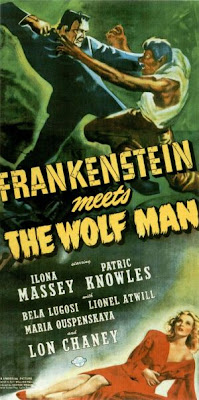
Enter Universal Studios. Between their one-two punch of Dracula and Frankenstein in 1931, and their first official monster rally with the 1943 release of Frankenstein Meets the Wolf Man, a dozen years would pass, but in the meantime, they laid the foundation for every monster rally to follow by establishing for mass consumption, under the uniform brand of a single studio, a canon of monsters in definitively iconic forms. One after another, they plucked inchoate creatures from the primordial soup of "ghoulies and ghosties and long-leggedy beasties," styled and baked and polished them into distinct and instantly recognizable characters, and, under the studio banner, assembled them more closely together than ever before in our collective imagination

By the time the idea for Frankenstein Meets the Wolf Man was explicitly proposed, Universal's corpus of horror could fairly be described as a virtual monster rally--an actual monster rally just waiting to happen. We can be sure that schoolboys were already hotly debating who would beat down whom if this monster crossed paths with that one. This is why it seems so natural that the mummy be included in the Hartman picture at the top of this post, though the mummy never appeared in any of the original monster rallies. Whether or not a particular monster appeared alongside others in any movie, and despite differences in setting and continuity, they all essentially belong to the same world of horror.

Of course, Universal never set out to lay this groundwork for a meeting of the monsters--that's just how things worked out--and they didn't get around to staging one until it was the blindingly obvious next step. Unfortunately, that point was reached only as the monster franchises were slipping into decline. Consequently, the monster rallies tend to be seen as symptomatic of that decline, if not partly responsible for it. The decision to combine the monsters looks like a cynical gimmick, and the execution is as indifferent as one would expect under such conditions. Here's how Curt Siodmak describes the genesis for the idea of Frankenstein Meets the Wolf Man:
Never make a joke in the studio. I was sitting down at the Universal commissary having lunch with George Waggner and I said, "George, why don't we make a picture Frankenstein Wolfs the Meat Man--er, Meets the Wolf Man?" He didn't laugh. This was during wartime; I wanted to buy an automobile and I needed a new writing job so I would be able to afford it. George would see me every day and ask me if I had bought the car yet. I said, "George, can I get a job?" He said, "Sure, you'll get a job, buy the car." Well, the day finally came when I had to pay for the car. George asked me that day, "Did you buy the car?" and I said, "Yes, I bought it." George said, "Good! Your new assignment is Frankenstein Wolf the Meat Man--er, Meets the Wolf Man! I'll give you two hours to accept!"
Whether this anecdote is strictly accurate or not, it certainly has a ring of sad truth about Universal's whole approach to the monster rallies.
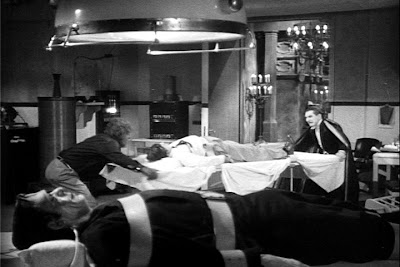
There are plenty of reviews around the internets for Frankenstein Meets the Wolf Man, House of Frankenstein, House of Dracula, and Abbott and Costello Meet Frankenstein, so I won't rehash synopses or the usual evaluative points. What I find most unforgivable is the failure of these movies to deliver on their fundamental promise as monster rallies. Frankenstein Meets the Wolf Man fares best in this regard--though tedious until the grand finale, it does ultimately deliver a scuffle between the Monster and the Wolf Man. In House of Frankenstein, the Dracula and Wolf Man stories are split into separate episodes, while in House of Dracula, they run on separate tracks, and in both movies the Frankenstein Monster is reduced to an inanimate prop until the very final moments. As long as the various monsters could be crammed together on the posters, Universal didn't seem to care whether the stories brought them together in anything like the way audiences surely hoped and expected. Ironically, Abbott and Costello Meet Frankenstein probably features the most monster interaction, but it is, after all, a comedy. I know a lot of fans claim it plays the horror straight, but that isn't quite right--the monsters are indeed played for laughs, it's just that they aren't the butt of the jokes. In sum, these movies fall short in any number of general ways, but they fail most miserably as the kind of movie they promise to be.

I don't think the Universal monster rallies were necessarily doomed to such ignominy. As I've tried to outline above, horror had been steadily evolving toward the monster rally over the long term, even before Universal. From this perspective, perhaps we can detach the monster rallies from their association with the decline of Universal's monster franchises, and see them more as a natural and inevitable development that happened to emerge during particularly unfortunate circumstances. Universal might very well have continued to produce excellent monster movies, or may even have proceeded to improve on them; I'm confident that in either case, it would have combined monsters in a movie sooner or later. Under those circumstances, the decision would seem far less cynical or gimmicky, and would be motivated to a much greater extent by artistic (i.e. as opposed to financial) considerations. More care would undoubtedly have gone into the writing and execution. Rather than representing the nadir of Universal's classic horror cycle, such movies might have represented the fullest culmination of its golden age.

That's just speculation, of course--there's no way to know what Universal could have done differently, or how it might have been received. What we do know is that the idea of the monster rally was just too good to die, no matter how badly Universal botched it. As we'll see, the idea proved quite popular and influential, and has taken some interesting turns.
Sunday, June 15, 2008

BRAND OF THE WEREWOLF by Kenneth Robeson (Bantam 1965)

Originally published in Doc Savage Magazine, January 1934
Reprinted by Bantam as DS # 5
Lester Dent writing as Kenneth Robeson

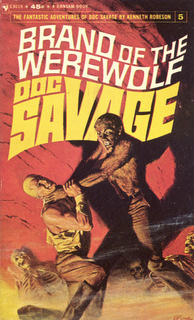
Doc Savage vs. the Wolf Man! That’d be cool if it were indeed the case, but the Bantam paperback cover is a total cheat — there is actually no werewolf to speak of in the story, certainly not the type of snarling lycanthrope (from the classic Lon Chaney Jr./Paul Naschy school) giving Doc a hard time in Mort Kunstler’s dynamic artwork.

Set entirely in the wilderness of western Canada, the story opens with Doc and his five assistants taking a leisurely train trip across British Columbia to visit Doc’s uncle, Alex Savage, at his massive Pacific coast estate. The boys are looking forward to a bit of camping and hunting, far removed from civilization, after a particularly harrowing adventure in Arabia (see Bantam # 10, The Phantom City). But trouble follows the Man of Bronze wherever he goes, even on vacation. A “weird sleep” overcomes certain passengers aboard the train — to include most of Doc’s men — and the conducter is found knifed to death. In each case the scene is marked by a stain or smudge, on wall or floor, in the configuration of a werewolf’s hideous face.

The key to the mystery involves a small ivory cube which a Latino gang will stop at nothing to get, to include killing Doc Savage and anyone else standing in their way. Whoever takes possession of the cube and deciphers its riddle stands to gain a lost treasure of gold dubloons and precious jewels worth millions. Doc’s uncle was murdered for the cube but the prize is still missing. Desperate to find it, the gang targets Alex Savage’s daughter, 18-year old Patricia, Doc’s only living relative (whom he has never met). Staying at her late father’s remote hunting lodge, Pat is totally alone except for two Native American servants. When night falls she hears the howl of a wolf echoing from the deep woods, a bestial cry that somehow seems to have a human quality…

While a pleasant enough time-waster, Brand of the Werewolf is an undistinguished potboiler notable only for the debut of cousin Pat, who’d become a semi-regular character in the series and a fan favorite. The book’s stereotyped depiction of Native Americans is embarrassingly cartoonish, even for the 1930s. (“Him heap bad customer!”) Dent neglects to explain exactly why the bad guys use the werewolf mark — intimidation, I suppose — and the master villain’s secret identity is ridiculously easy to guess… even if it weren’t blatantly given away from the get-go, which it is, right there in the back cover’s plot description. (Note: I was quite surprised to learn that this was the best-selling volume of all the Bantam reprints, with over 200,000 copies sold. Due to that misleading cover art, no doubt.)

Grade: C+

Wednesday, May 23, 2007

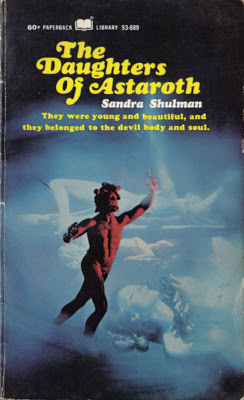
DAUGHTERS OF ASTAROTH by Sandra Shulman (Paperback Library 1968)


Niall Tregellis (how's that for a name?) notices rising levels of chaos throughout the world--war, famine, pestilence, and death. Specifically, he notes that many beautiful young British high society ladies are committing suicide. They all have two things in common--the bizarre little figurines they were known to carry around with them, and the fact that they all graduated from the exclusive Abbey of Light finishing school. Some top-secret intelligence agency actually calls him in and puts him on the case, because they're afraid these suicides will somehow disrupt upcoming talks with the Soviet Union.

So he goes to the Abbey of Light, and there he finds a werewolf, teachers who are sexy witches (one of whom I pictured as Rosalba Neri) , black magic worship of the pagan demon-deity Astaroth, and the thirteen girls who committed suicide wandering around undead in a graveyard. The werewolf, by the way, is a Nazi. I guess there's just no escaping those bastards!! Prisoners are chained in caves and tormented by demons. Naked girls are chained to altars. Crucifixes are brandished. Stakes are hammered through hearts. In an enchanted bowl of water, the headmaster shows Niall a prophetic vision of the Soviet leader's assassination, and the apocalypse to follow in which rats take over the world (I'm not kidding).

This is truly a groovy gothic train wreck. The writing is so atrocious, I almost stopped reading a third of the way in. But that's when it began to pick up steam; fortunately, I decided to keep on, curious to see where it was going. It throws pulpy gothic cliches around with an almost surrealist disregard for any kind of sense or order. It reminded me, in fact, of some of my favorite eurotrash horror movies.

Make no mistake, this is an awful, cringe-inducing, painful-to-read mess of a novel. And against my better judgment, I highly recommend it. Take that any way you want!

Trash Fiction had a lot less fun with this, it seems.

Tuesday, November 28, 2006

Speaking of London and Naughty Nurses . . .

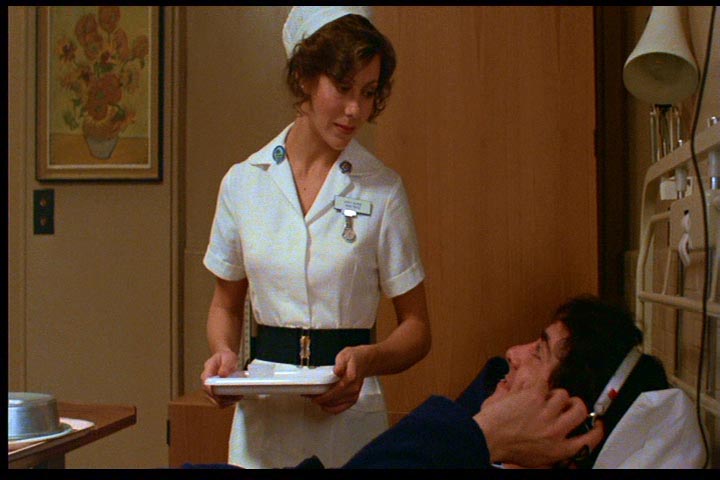
My all-time favorite cinematic nurse is Jenny Agutter's Nurse Alex Price in American Werewolf in London. I mean, wow!--does it get any better? Check it out:


She cuts a fine figure in that uniform, for sure!


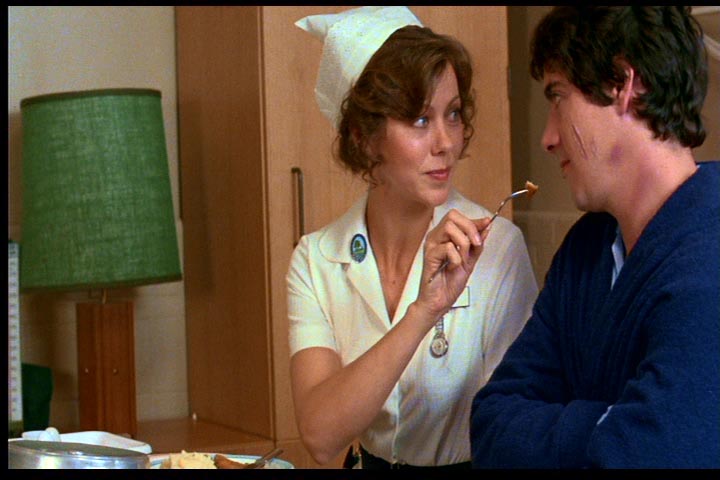
Now that's what I call health care! But it gets better . . .


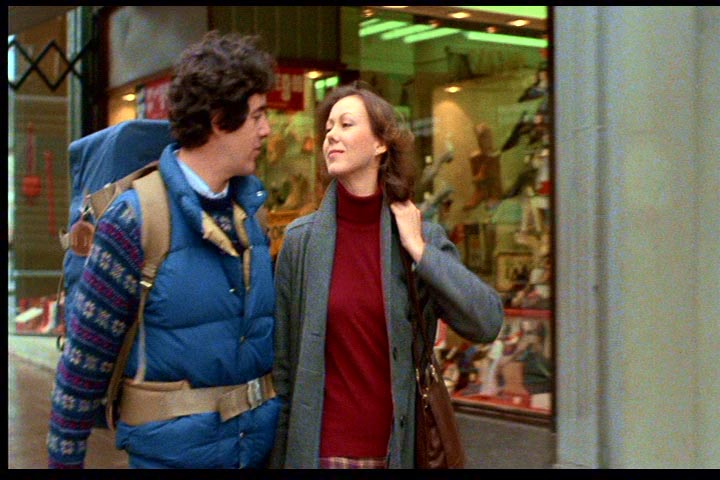
She'll take you home (and looks great out of costume, too).


Nicely naughty.


Very nicely naughty!


Florence Nightingale to the end--even when she's facing this!


Wow, beautiful. Just beautiful.

Wednesday, October 18, 2006

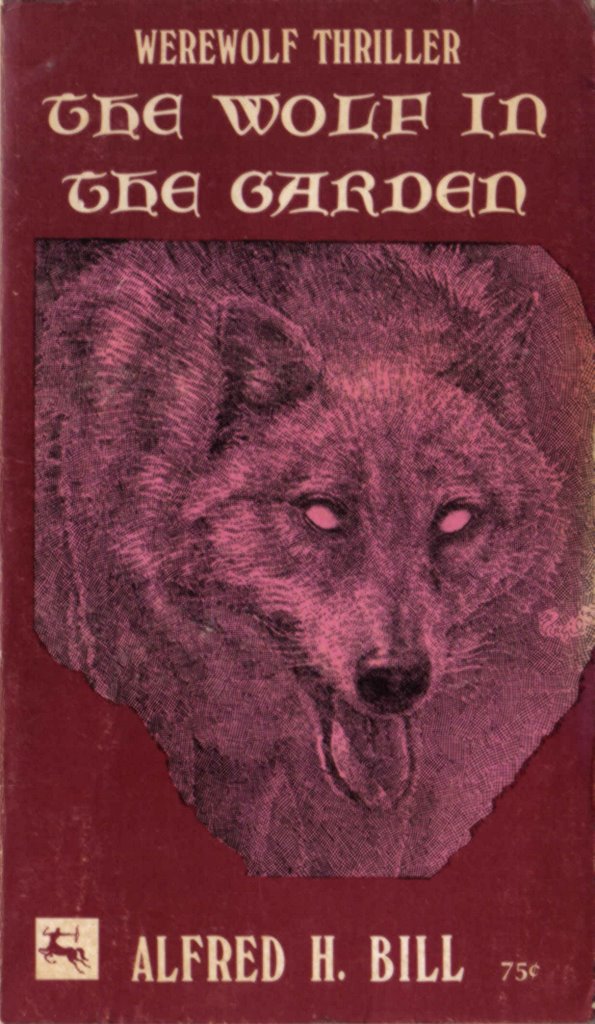
THE WOLF IN THE GARDEN by Alfred H. Bill (Centaur 1972)

Here's another fine reprint by Centaur of a gem, originally published in 1931, that might otherwise have been lost to obscurity. The sad truth is, it's still rather obscure, despite being a smart, engrossing werewolf thriller with a truly supernatural beast.

A rash of wolf attacks plagues a small New York town shortly after the arrival of a wealthy French aristocrat, in exile from his own country following the Revolution. The town is sufficiently embarrassed by having hanged a "witch" a century earlier that it refuses to fall prey to superstition again, and steadfastly turns a blind eye to the increasingly obvious connections between the Frenchman and the marauding creature. He exploits his wealth, smooth manners, and sometimes intimidating aspect to secure an engagement with the protagonist's true love, a Southern lady whose "Haytian" servant is secretly a voodoo priestess with some impressive supernatural talents of her own. Throw in a dead miser's lost hoard, a suicide, and a "strip of human skin taken from the living body of a beautiful Circassian female slave . . . removed from her living body in a single strip as one peels an apple," and you've got something pulpy and penny-dreadful-ish, if not exactly groovy. Oh yes, there are silver bullets.

If you love werewolves, I highly recommend this. And the late fall, early winter setting makes it perfect reading for this time of year (I write as Halloween approaches).

Monday, October 16, 2006

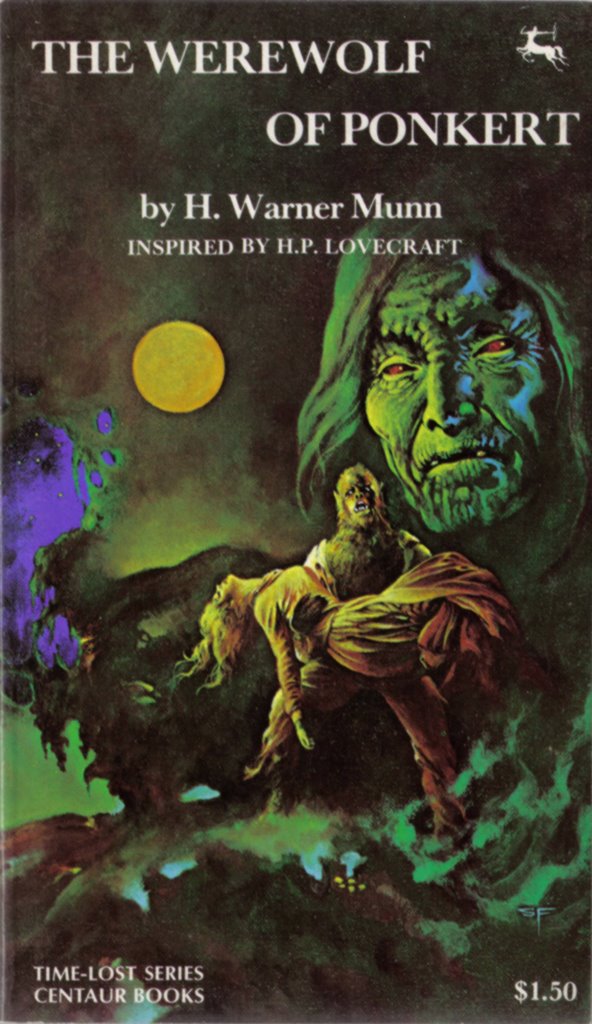
THE WEREWOLF OF PONKERT by H. Warner Munn (Centaur 1976)

This volume actually collects two novellas, The Werewolf of Ponkert, and its sequel, The Werewolf's Daughter, both of which first appeared in Weird Tales, in 1925 and 1928 respectively, the latter as a three-part serial. The Introduction mentions other stories Munn wrote for the series, and after reading these, I'm inclined to track them down.

The story behind these stories is that H. P. Lovecraft apparently wrote a letter published in Weird Tales suggesting that someone write a werewolf story from the werewolf's point of view. The first story is just that--the story of how an ordinary man came reluctantly to serve Satan as part of a werewolf cult/pack. When he tries to turn the rest of the pack against their Master, Satan makes a terrible example of him. He gives himself over to the religious and secular authorities, and makes a full confession which is then printed on his flayed hide after his execution.

The second story deals with his surviving daughter, who isn't a werewolf, but who is regarded as a witch by the town. The only reason they haven't burned her yet is that the officer who arrested her father has taken her into his care, and he's not one to be trifled with. The story begins many years later, when the officer is old and his health is failing. The girl has grown into a pretty young woman. A passing "gipsy" falls in love with her, despite the dire warnings of the fortune-teller who's been like a mother to him. Meanwhile, the Master from the first story is hanging around, still so vengeful toward the werewolf that he's trying to arrange the most horrible death he can for the daughter.

Both stories are outstanding, in my judgement. The first is just a great werewolf story, and the second is good enough that I don't even mind that it doesn't have a werewolf. Of course, there's nothing groovy about them, since they were written in the twenties and set much earlier than that, but even so, the fact that this reprint was issued in the seventies tells us something about the Groovy Age and its ravenous taste for horror. I highly recommend this, and like I said, I'll see about finding the rest of those werewolf stories by Munn.

Wednesday, December 07, 2005

SKYWALD'S DRACULA, "LIEGE OF LYCANTHROPES"

Skywald's Dracula as boy, as man, as werewolf . . . and as vampire.


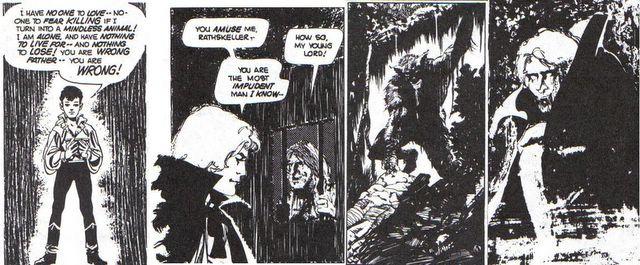
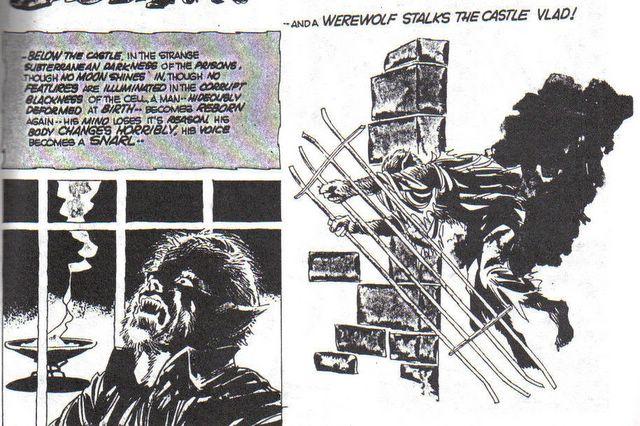
In just the one reprint volume and one actual magazine I own, Skywald presents any number of conflicting versions of Dracula. One mini-series (I think it's only two installments, one in Scream #10 and the other in Psycho #24), "A Fragment in the Life of Dracula," makes up an origin for the dread Count that is uniquely Skywald's (at least, I've never seen it anywhere else). In this version, Dracula begins his reign of terror not as a vampire, but as a werewolf!

When Dracula is just a little boy, he watches a rampaging werewolf maul his parents. The werewolf is badly hurt, though, and little Vlad finishes it off with a saber his father dropped. He urges his dying father to drink the werewolf's blood and live, but his father refuses to go on as a monster, and dies. Dracula, despising his father's scruples, seizes the opportunity for immortality and power, and drinks a hefty goblet-full.

So how does he become a vampire? In the next installment, the cruel Count sets a prisoner free and hunts him for sport by the light of the full moon. When he's brought the man down, vampire bats descend on the carrion to join him in the feast. In all their greed, he chows down a few bats, and some of them nip him as well. Thus is blood exchanged, and thus Dracula becomes the legendary vampire.

The art, by Jose Cardona and Roberto Martinez, beautifully evokes the trademark "Skywald Horror Mood," and the stories are by Al Hewetson.

Friday, September 23, 2005

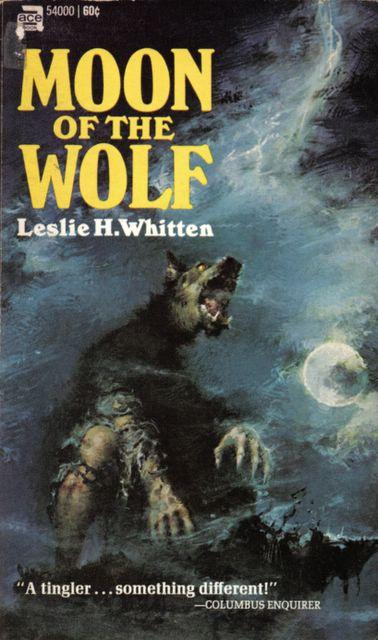
MOON OF THE WOLF by Leslie H. Whitten (Ace 1967)

This is the story of a deputy sheriff in a Mississippi county in 1938. The savage killing of a black girl, apparently by wild swamp dogs or possibly even a wolf, sets off a spiral of further violence, paranoia, class and racial tensions, and superstitions from both Europe and Africa. Is a werewolf behind it all? No.

There is no werewolf here--only a man with the psychological disorder of lycanthropy. It does dramatically alter his appearance and make him physically more bestial, but there's nothing supernatural in this book, and certainly nothing that even remotely corresponds to that awesome werewolf on the cover.

Don't stop reading yet, though--this is an excellent novel and I highly recommend it. I just can't recommend it as a werewolf novel. And that's damned frustrating. Stay with me, because I'll come to the positive, but first I have to vent. Send the children from the room. They really shouldn't hear this. If you don't care to hear it, just skip the next long paragraph.
If an author is going to tease readers with the supernatural, why not just go ahead and deliver it? For chrissake, that's the hook that made them shell out their cash. That's why they fucking bought the book. It's what they fucking want. If you, an author, can't take supernatural horror seriously enough to follow through with it, then don't fucking dangle it in front of readers' noses. Because they do fucking take it seriously. Not for real--not in their daily lives. But that's the kind of fantasy world they want to get lost in. Just look at the werewolf on that cover! That's why I bought this book. I know Leslie H. Whitten didn't paint the cover or even select it or anything like that--but he did thread coy hints about werewolves all through this motherfucker. Halfway through, it didn't seem unreasonable to hope that a real werewolf might be lurking at the edges of the story. And that, to me, makes Leslie H. Whitten sufficiently responsible for the false advertising. Everyone loves to quote that rule: if you show a gun in the first act, it has to go off in the third. It's a basic principle of delivering on promises. Why can't anyone get that right when it comes to horror?
Whew! With that out of the way, I have to say that this is really an outstanding novel. The characters are vivid, alive, and engaging. I felt for every one of them. The story kept me turning pages, immersed in the action. The most amazing thing this novel has to offer, though, is its depiction of Depression-era Mississippi. Whitten does an uncanny job of evoking the physical setting in colors, shades of light, scents, textures--I mean, I really felt like I was there! Just as expertly, he made me feel every nuance of the social and racial atmosphere. Nothing I've read in any literature class--not Harper Lee or Faulkner or Flannery O'Connor or any of them--brought the South as vibrantly or comprehensively alive for me as Whitten does here. Consider how much he conveys in just these few paragraphs, about a hunting party preparing to set off after what they believe to be a wolf:
Next morning, by nine o'clock, a dozen men and thirty dogs were gathered behind Gurmandy's barn. The air was still chill enough to fog the moisture from the horses' nostrils. Whitaker [the protagonist], astride the big gelding, was next to Dr. de Glew and his fine brown mare.

Sergeant Mumford stood glumly beside another gelding. From time to time, a grinning redneck named Filberts tried to strike up a conversation with Mumford. Filberts' passport to the hunt was his "wolf dog," a long-toothed, long-haired bastard breed of what appeared to be every oversized dog that had ever set paw in Mississippi. Somewhere in its background was a shameful alliance between a pure wolfhound and some gigantic mongrel. But only the renegade wolfhound's leanness now remained in the polyglot of Doberman, collie, German shepherd, mastiff, Great Dane and Saint Bernard. Even Mumford's mongrel beagle avoided the flea-ridden and mangy animal. But the "wolf dog" was big, and appeared fierce.
Apart from the other hunters was Andrew Rodanthe, waiting calm as black swamp water upon his mahogany stallion, Giaour. He had once explained with a leer that it was named after an aunt in Biloxi. An aging Negro, Jerome, who worked as his houseman, was holding two blooded bassets, Rodanthe's contribution to the pack. They, like Rodanthe, would not mingle until the chase was on.
I've lived in Mississippi and I live in Georgia now, but I am definitely not a Southerner. In many ways, I vehemently, venemously despise the South. But Whitten makes it beautiful, with no apologies for what it is.

In conclusion, I thoroughly enjoyed this novel, except for that sinking feeling when I realized there wouldn't be a werewolf. Would I recommend it? Yes, but not not as horror.


Werewolf by Berni Wrightson, from Swamp Thing #4 (reprinted in Swamp Thing: Dark Genesis).

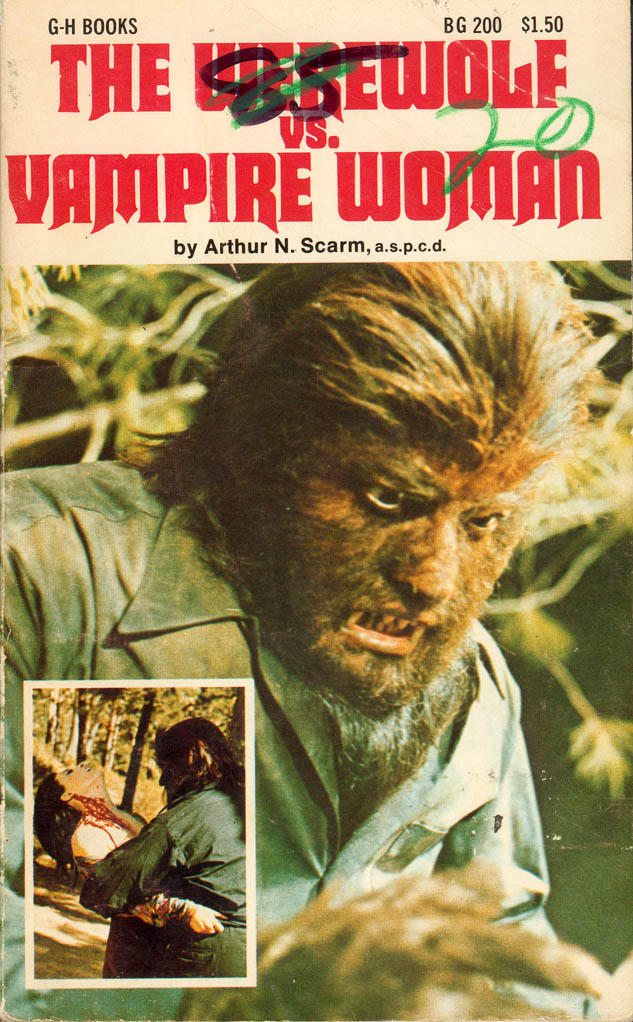
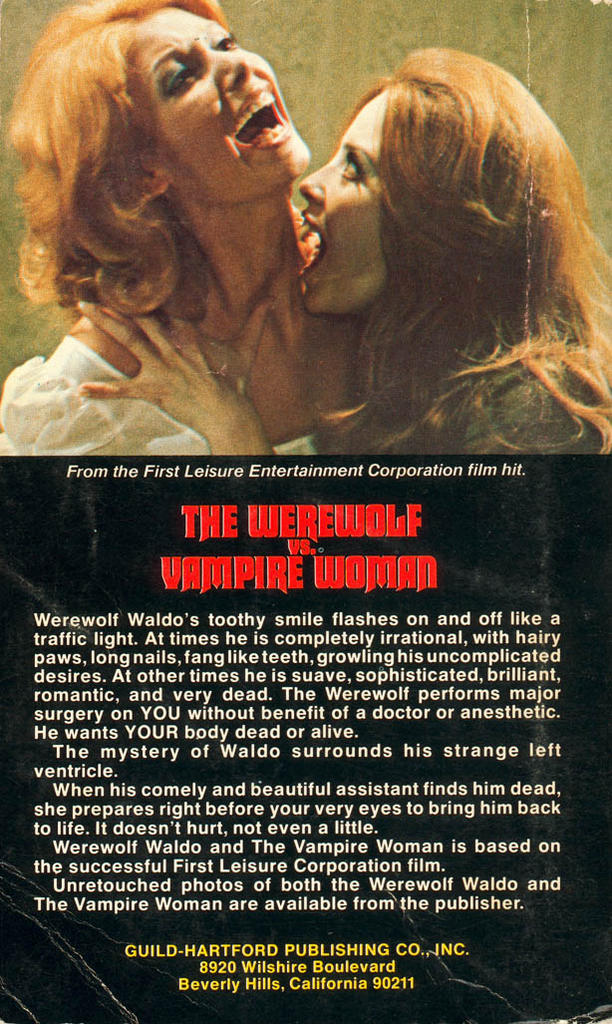
THE WEREWOLF VS. VAMPIRE WOMAN by Arthur N. Scarm (Guild Hartford 1972)

Guest Review by Tom Bagley

When I was a horror-crazed little kid back in the early 70's, I used to pore over the entertainment pages of the newspaper, cutting out any and all movie ads that looked to have even the remotest horror content. One time, my eyes fairly bugged out when I found an ad for something called Werewolf's Shadow, playing at the bottom of a double bill with something else called Dracula, Prisoner of Frankenstein. I found out it was the work of one Paul Naschy, through the pages of Marvel's marvelous Monsters of the Movies mag. The photos they ran of the drooling, snarling, be-chained Waldemar Daninsky were definitely very cool, and at the time, the height of true werewolf savagery chic. Many years later, I was finally able to see Werewolf Shadow (the correct title), AKA La Noche de Walpurgis, AKA The Werewolf Vs. The Vampire Woman, on a video bearing the title Blood Moon. It remains a nice, gory classic of 70's Eurotrash, and a vast improvement over the only other Naschy wolfman movie I'd seen up to that point, the patchwork Fury of the Wolfman. Around the same time, I found this tie-in novel at a local mom n' pop-run used book emporium here in Calgary for 20 cents (Canadian!). I immediately grabbed it, as it was such an oddity and something that I had no clue even existed. After reading the cover blurb, it was obvious that the book strayed considerably from the plot of the movie, and it eventually was consigned to the back of the heap of my horror paperback collection.

Anyway, at Curt's urging, requesting readers of this esteemed blog to come forth with any suggested novels for Werewolf Month, I dug it out and dusted off the cobwebs so I could scan up the cover for him. Curt then suggested that I actually read and review the damned thing, as the chances of running across a copy of it himself this month were mighty slim, so here goes!

I'll be brief with the plot summary: Waldo the Werewolf is brought back to life by a coroner removing the silver bullet from his heart. Waldo then kills the coroner and rapes his assistant, Ruth, who falls in love with him. At this point, Genevieve and Elvira (two medical students) enter the story briefly, searching for the secret grave of Wanda de Nadasdy, queen of the vampires. For no other reason than Waldo hating vampires, he teams up with them, has lots of rough sex, locates the grave, and brings Wanda back to life so he can kill her again. Then all the human girls get killed as Waldo teams up with Wanda and the two of them go off on a murderous rampage. Eventually, to avoid the police, they end up in Hollywood as movie stars, try to reform, and end up killing each other at the novel's conclusion.

The book is a confused mess, starting off like a porno parody of the actual film it purports to be based on, then goes off on its own murder spree as an episodic, gory free-for-all, and finally turns into a rather soft-hearted romance (!), as the two protagonists fall in love with respective individuals who attempt to help them reform and become compassionate humans.

A bit of digging on the Internet has informed me (thanks to Juri Nummelin's Pulpetti blog) that the author, one Arthur N. Scarm (or Scram, according to the title page), is possibly also known as Leo Guild. He is credited with a number of books dealing with various concerns for the African-American specialty publisher Holloway in the 60's and 70's. I'm curious as to whether or not any of his other writings are as unhinged or headscratch-inducing as The Werewolf Vs. the Vampire Woman. The novel is written in a strange style, somewhat reminiscent of the writing style used in Curious George books; that is, if the Curious George books were rambling diatribes containing rape, anal assault, pedicide and assorted creative sadisms leading to sudden death. It all seems be very stream-of-consciousness in its execution, with bits of weird, seemingly made-up-on-the-spot werewolf and vampire lore sprinkled throughout. For instance, Waldo doesn't actually look like a werewolf except on New Years Eve. The rest of the time he is distinguishable by a band of thick fur around his BVD line. He also has a massive wang, but like all werewolves (according to Mr. Scram), he can never ejaculate. Which is maybe why he is such a murderous beast. He can also invade people's dreams, and on his one night of furry werewolf-dom, he can wish himself to magically appear anywhere he pleases. Wanda isn't quite so murderous and is the more levelheaded and remorseful of the pair, although she often gets into trouble due to her irresistible yen for the fairer sex, leading to lesbo lickfests and sustenance intake.

All in all, a very bizarre and entertaining book and an apparently collectible artifact from Back In The Day. It does leave me wondering why they bothered to pick on this particular flick to novelize in the first place. Many thanks to Curt for suggesting that I haul out this odd piece of 70's werewolf ephemera and give it a going over, resulting in a highly amusing and bewildering read.

[Thanks Tom! I've located exactly one copy of this on the internet, and it's going for $80! So I appreciate the scans and the thoroughly entertaining review. Werewolf Month wouldn't have felt right without it.--Curt]

Wednesday, September 21, 2005

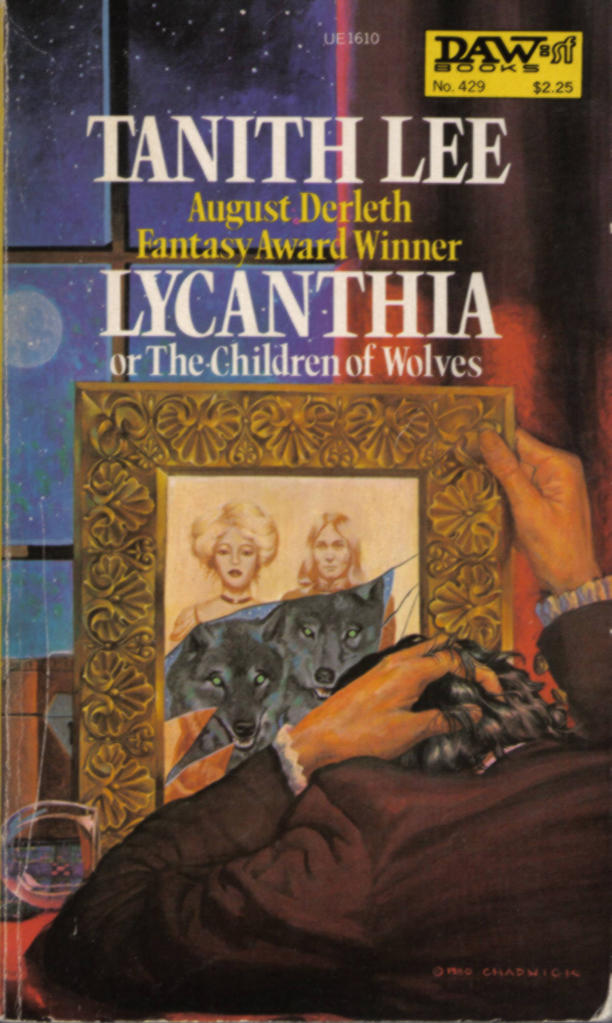
LYCANTHIA by Tanith Lee (Daw 1981)

Christian, dying of consumption, goes to spend his last days alone in an all-but-abandoned chateau he has unexpectedly inherited. He arrives by train in the anachronistic northern French village to which he is now le seigneur. He finds himself immersed in a world of transparently Catholicized heathenism--artifacts, practices, and beliefs whose pagan origins have been draped with the merest of fig leaves by centuries of village priests.

Even the ubiquitous cross is more primal, perhaps, than any religion. The village displays it in a weird, lopsided manner that increasingly irritates Christian, until someone explains that it's not really a cross, but rather a symbol they call the Lysinthe. It represents, in fact, the instinctive gesture when a wolf lunges for your throat: one forearm horizontally offered to the teeth, and the other bracing it vertically from behind, at or near the wrists.

Oh yes, there are werewolves. Real ones. We see the transformation before Christian's very eyes. Shunned by the village, the beautiful mother and son live in a fairy-tale-ish cottage deep in the woods adjacent to the chateau. Despite some initial tension, they soon come to an understanding with Christian—enough of one that they move into the chateau for incestuous threesome sex all day (besides being mother and son, they're a bastard branch from Christian's family tree) and werewolf antics all night.

Naturally, the villagers find this development revolting, so they . . . well, revolt. We get an awesome scene of a torch-wielding mob storming the chateau. Despite the profusion of such great B-movie elements, Lee's werewolf novel is much more Pre-Raphaelite than pulpy. She brings a sensibility that is feminine, feminist, and affectedly French.

I enjoyed it immensely until the very end. Sorry if this spoils anything, but in typical Decadent fashion, we get a hero who fails to rise to the occasion. He's quite snotty, self-pitying, and generally unlikable for most of the novel. Just when we believe he's been redeemed (in human terms if not exactly religious ones), the worm turns--for the worst.

Would I recommend Lycanthia? Yes, but not to everyone, despite its high quality. If you're one of those ass-wipes who bitches about how "arty" and "French" Jean Rollin's movies are, then by all means, stay away.

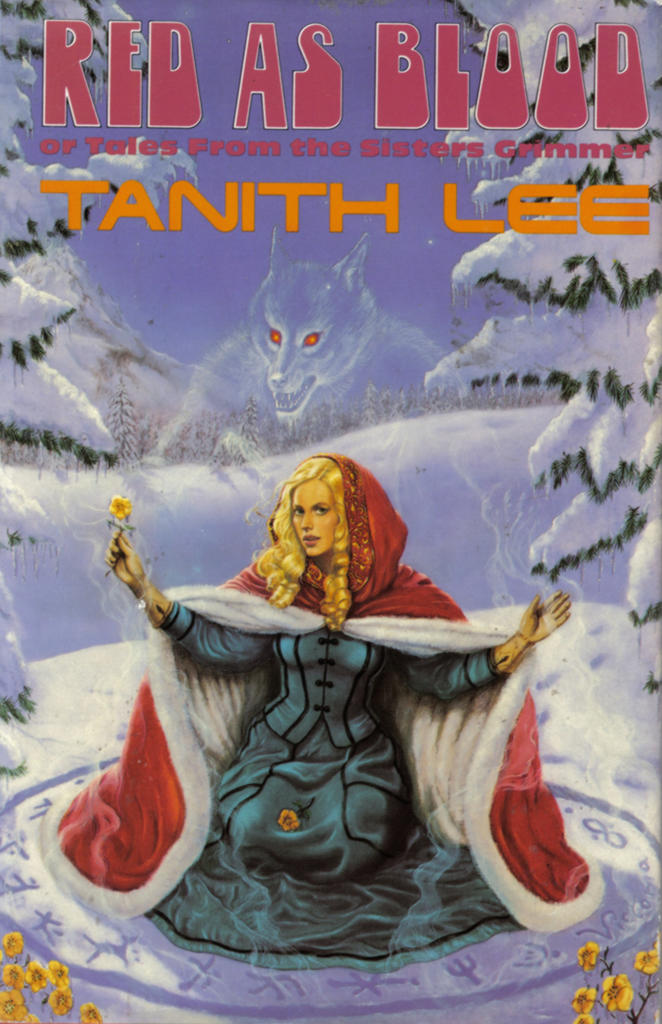
This isn't the only werewolf yarn Lee has spun. In Red as Blood, her volume of Angela-Carter-esque fairy tale retellings, she gives us "Wolfland," her take on Little Red Riding Hood. I'll be honest: I just eat stuff like this up. I've titled my own novel Night Falls on a Fairy Tale, and I'd credit Lee as an important influence.

Monday, September 19, 2005

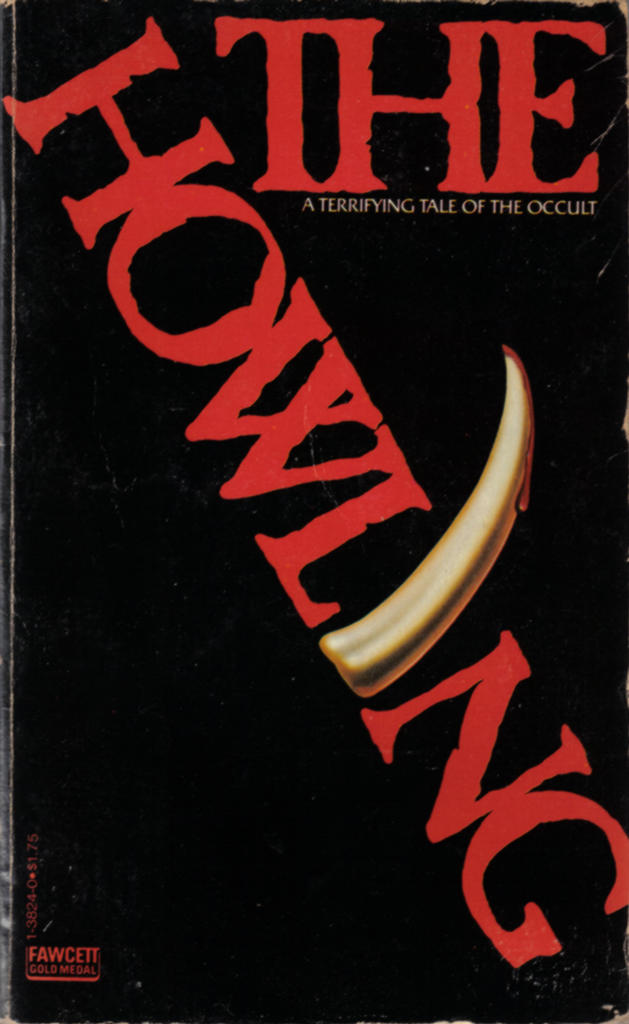
THE HOWLING by Gary Brandner (Fawcett Gold Medal 1977)

This is not a novelization of the movie; the movie is an adaptation of the novel. In fact, Brandner's Howling II hit bookshelves well before the first movie showed in theaters. Now, the movie kicks so much ass that you might be wondering what point there could be in reading the original novel. Perhaps reinforcing that impression is the fact that you can march into Best Buy and pick up a Special Edition dvd, but the book is out of print.

I'm here to tell you that the book is absolutely worth a read, even if you have the movie memorized. The movie departed from the source material dramatically. I'm not complaining. Quite the contrary! The movie still kicks ass, whether it was "faithful" to Brandner's vision or not. The good news is that if you've only seen the movie and haven't read the novel, something different--something surprising and magical--still awaits you.

I don't know what it is about California and werewolves (Marvel's Werewolf by Night is also set, for the most part, in California), but it works. The novel begins in L.A., not with a reporter, as in the movie, but with Karyn Halloran, whose occupation is basically irrelevant to the story, making her a kind of Everywoman. Instead of facing a serial killer in a porno shop, she's raped in her condo unit by one of the ubiquitous lawn-care guys (that seems to be a universal nightmare of privilege: the violent and often sexual revolt of "the help").

Where the movie actually sticks more firmly with the whole California thing, setting the werewolf pack in a stereotypically Californian communal therapy retreat, the novel takes a different turn. There's a prologue that tells the old werewolf legend of a Bulgarian village--or what used to be a Bulgarian village, since the legend makes it clear that angry neighboring villagers burnt it to the ground and wiped it off the map. The village's name was Dradja. As it happens, there's a little . . . well, village tucked up among the mountains of northern California, and that village's name is Drago. Coinky-dinky? I thinky not! Karyn and her husband Roy decide to get away from the city for six months, so they rent a little fixer-upper in Drago, fix it up, and move in.

Brandner nicely creates a growing sense of Something Wrong about the town. The werewolves emerge out of the night, and they're real. Though they differ quite a bit from those in the movie (which, by the way, are among my favorite werewolves in any medium), they have their own dark charm and appeal. They're gorgeous figments of Old World superstition come nightmarishly to life. When they surround the cottage for the grand finale, the effect is drenched in Fairy Tale enchantment. On top of that, we get some cool werewolf vs. werewolf action, which is always a good thing in my book. And just to remind us that we're still in California, we get the mysterious, madness-inducing Santa Anna winds.

I'll be referencing this novel in further posts this month, but for now, here's my thumbnail review: HIGHLY RECOMMENDED!

I'm definitely itching for the sequel, but that will have to wait for another Werewolf Month.


Vampirella tangled with a werewolf in "Isle of the Huntress," originally presented in Vampirella #14 (1971), reprinted in Vampirella vs. the Cult of Chaos tpb, and colorized (ick!) in Vampirella Classic #3.

Metamorphoses

In conceptualizing a werewolf, the two main questions that emerge are What kind? and How does it transform? Cinematically, Universal's classic Wolf Man has served as one pervasive model for answering the first of these.

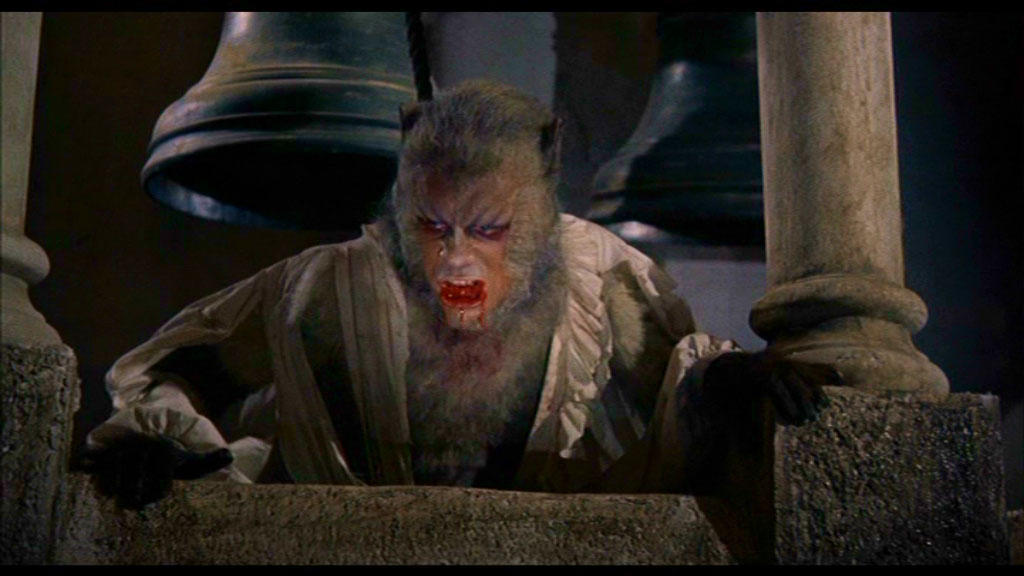
Hammer's Curse of the Werewolf, for example, uses a wolf man, as does Paul Naschy for all his Waldemar Daninsky movies. Makeup-wise, it's no doubt the simplest and most efficient version to achieve.

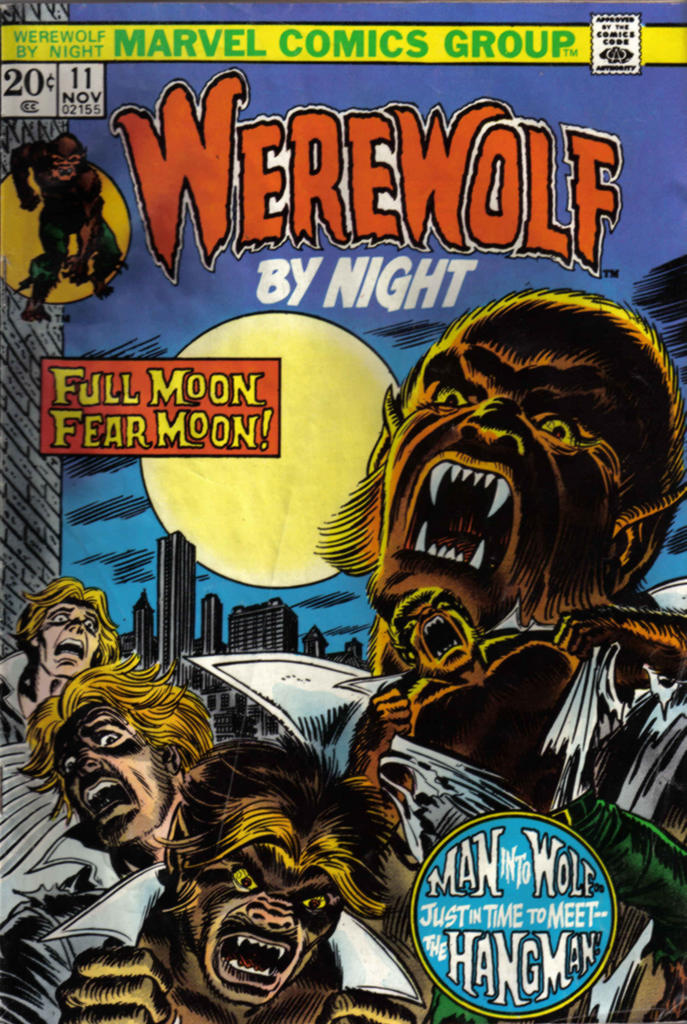
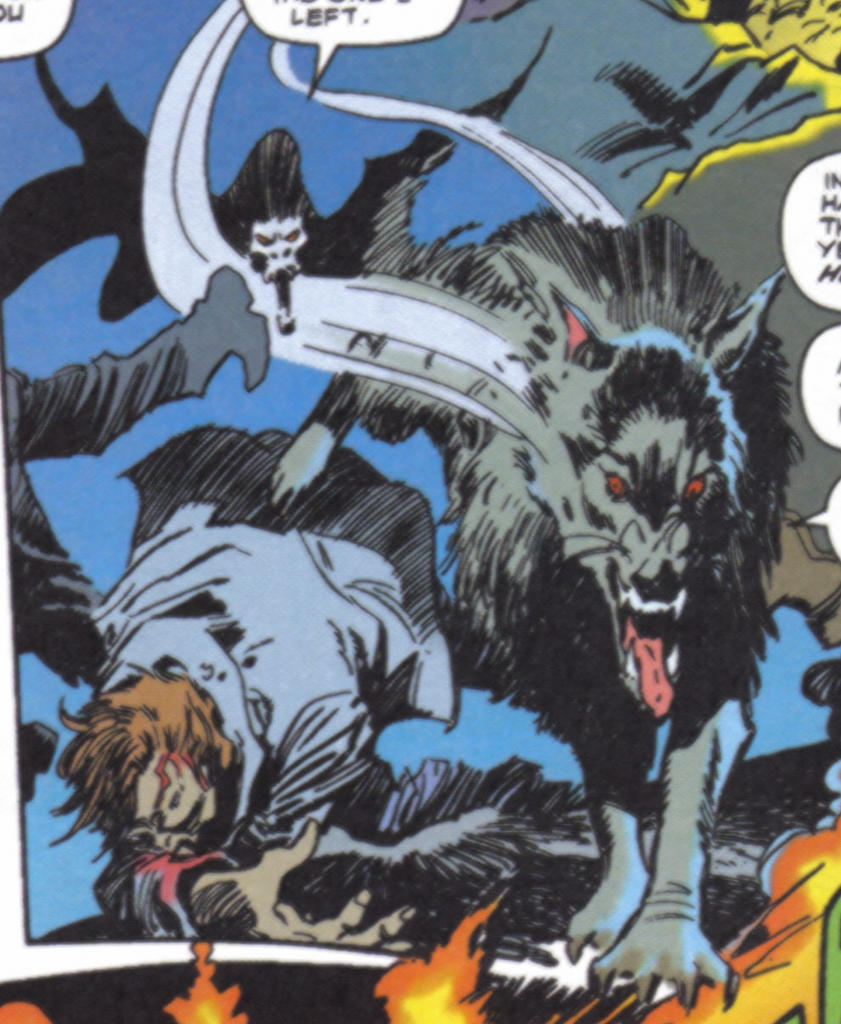
We find the influence even in comics, such as Marvel's classic Bronze Age series, Werewolf by Night.


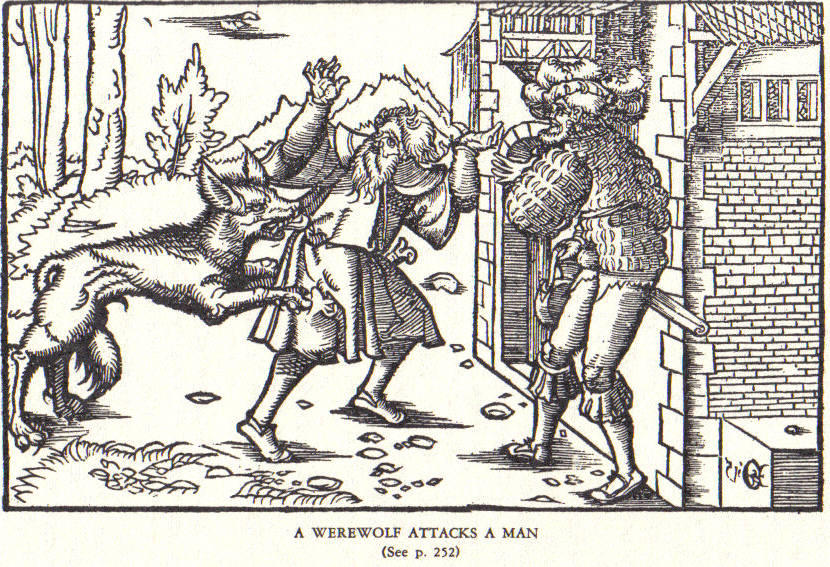
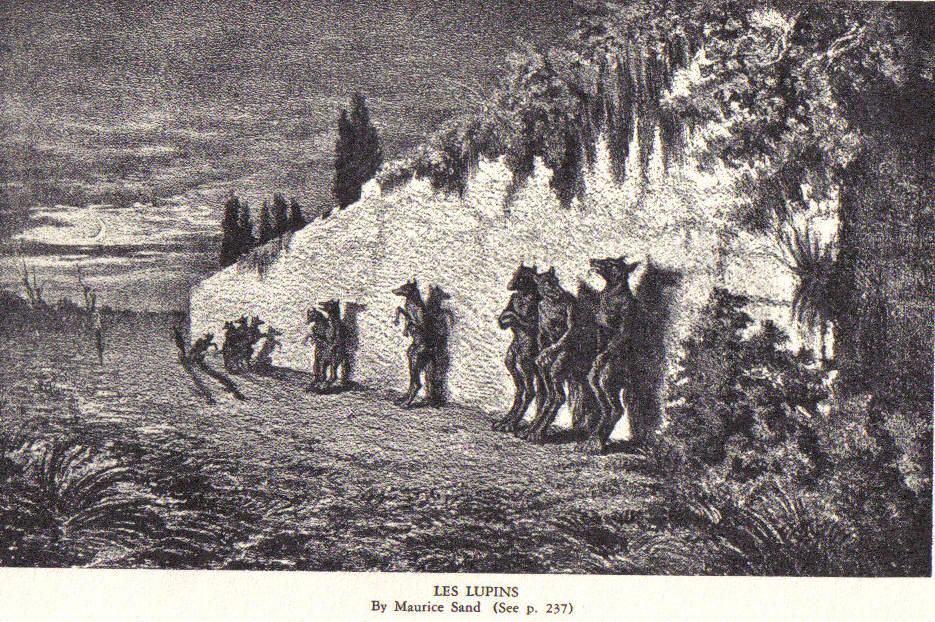
Then there's the "four on the floor" look, as seen in this woodcut illustration. Whereas the Wolf Man version emphasizes the "man" side of the equation, this version emphasizes the beast.


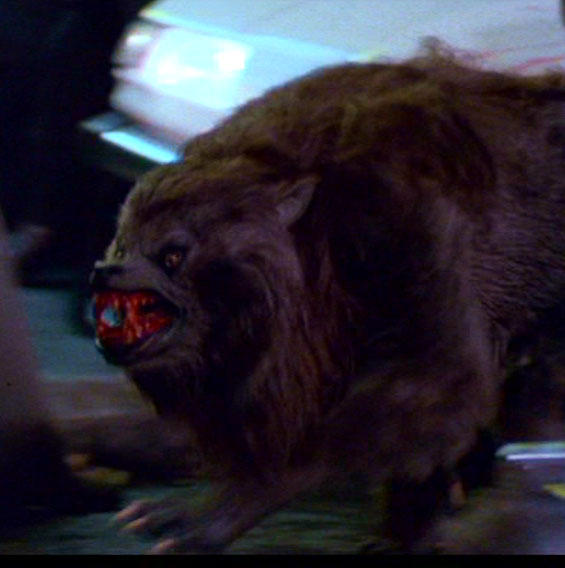
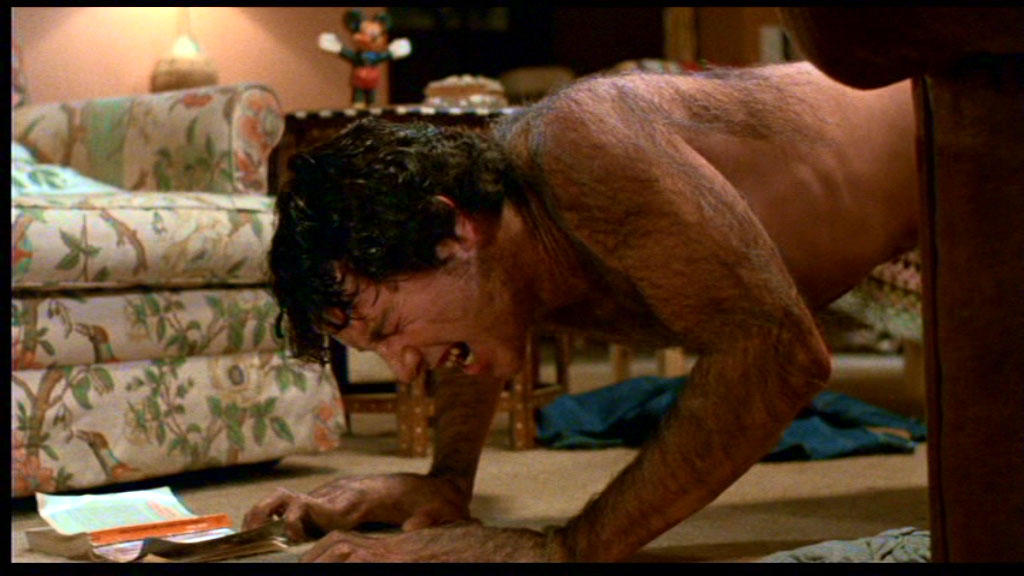
This is the route director John Landis took for American Werewolf in London.


My favorite version, though, is the look of a wolf standing upright on hind legs. It preserves the bestial in a way the Wolf Man version doesn't, while also anthropomorphizing it in a way the quadrupedal version doesn't.

The Howling effectively brings this look to the screen--for the first time, if I'm not mistaken.

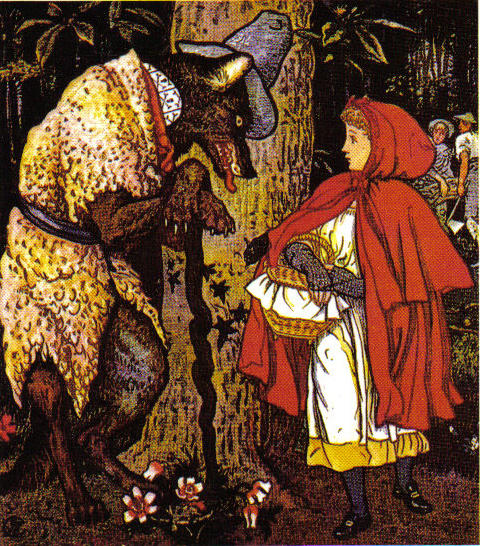
The allure of this version is its connection to stories from childhood, in which animals appear and act as human-like characters, as seen for example in this classic Walter Crane illustration of Little Red Riding Hood.

Director Joe Dante makes the association explicit by showing this cartoon of the Big Bad Wolf.

Turning now to the question of transformation, most conceptions of werewolves that I see in pop culture tend to emphasize the sheer physicality of the process. It happens in stages and spasms, and is difficult for the person undergoing it.

Probably the most pointed example is American Werewolf in London. Makeup artist Rick Baker explains director Landis's conception like this: "if your whole body is changing into a different creature it would be a painful experience and he wanted to show the pain and have movement."

Director Stephen Sommers bought into this conception even in his attempt at innovation, in Van Helsing, in which he depicts the human ripping off skin to reveal the wolf underneath.

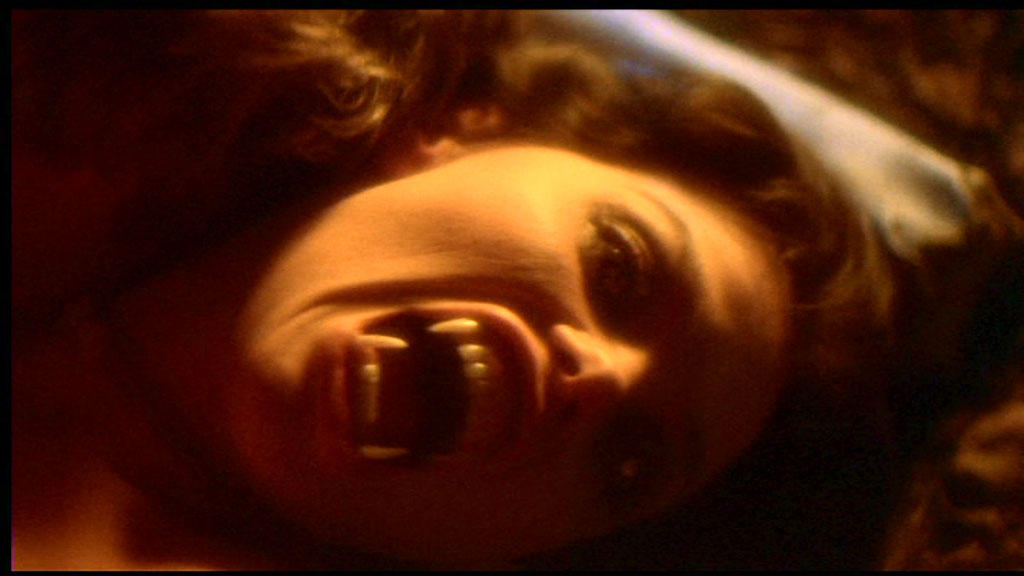
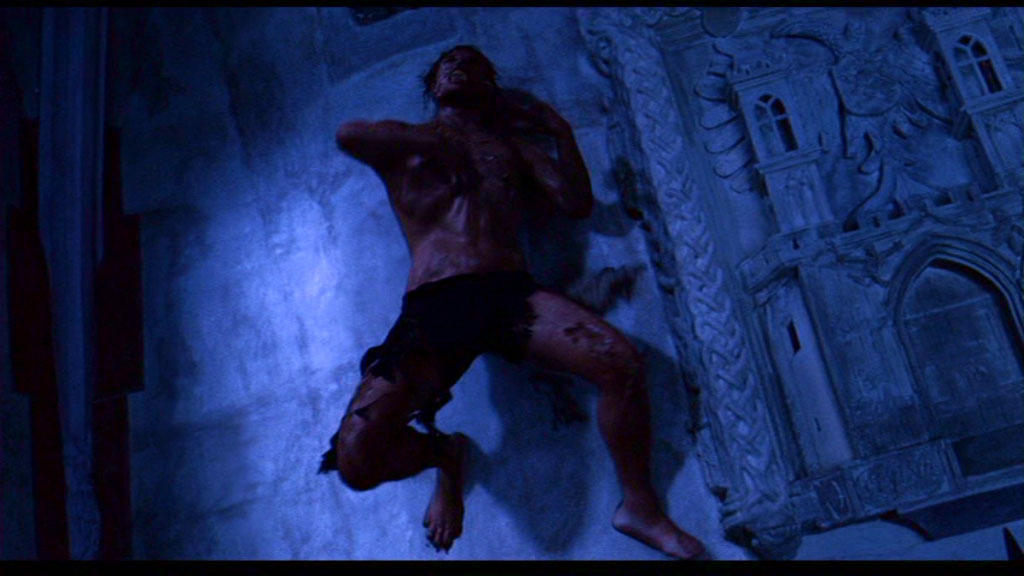
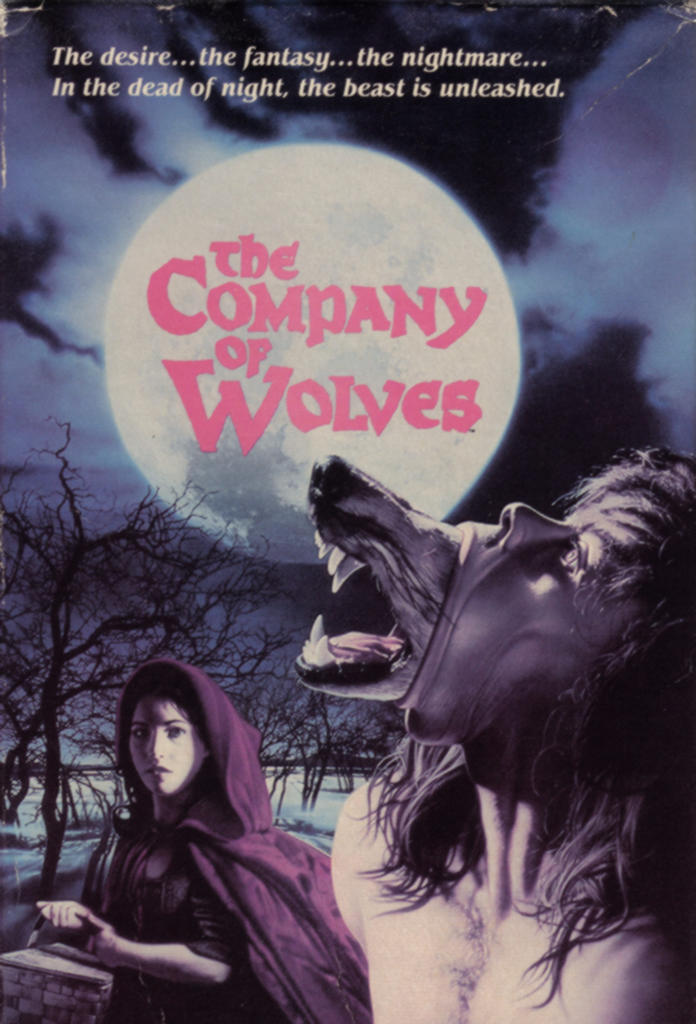
Of course, he wasn't nearly as original as he thought. This approach had already been taken in Company of Wolves . . .

. . . to much more disturbing effect. In any case, this notion of peeling off skin actually has some foundation in the folklore, where we find both humans putting on wolf-pelts to effect their transformations, and humans with fur growing on the inside. I think this skin variation on transformation emerged out of a different experience than the more cinematic metamorphosis. It probably has its basis in the experience of actually wearing skins for warmth, and observing other people wearing skins, as well. Considering the psychological significance of clothing, especially when it alters shape or appearance, and most especially when it serves to mask or disguise identity, it should be no wonder that someone would feel different when they wear the skin of a feared predator, nor should we be surprised at the feelings evoked in others by such garb.

Coming back to the more literal metamorphosis variation, though, in which the werewolf's body itself goes through the change, I believe an entirely different experience gave birth to it in folklore and superstition. I agree with Ernest Jones, that nightmares gave rise to this conception:

There can be little doubt that the idea of metamorphosis has important sources in dream experiences, for here the actual transformation of the figure of a human being into that of an animal and the occurrence of composite beings, half animal, half human, so often takes place directly before the eyes of the dreamer.
In order to understand why this should be so, and what it might mean for werewolves, compare Jones' remarks with these, by Susan J. Napier, about metamorphosis in animation:
Indeed, what animation can do to the human body is one of the most interesting and provocative aspects of the medium. . . . the animated body is perhaps best understood in relation to the process of metamorphosis. As Paul Wells suggests in his book on animation, metamorphosis may be "the constituent core of animation itself." Since movement is at the heart of animation, animation can and does emphasize transformation in a way that simply no other artistic genre is capable of doing.
What dreams and animation have in common is precisely this: imagery unconstrained by physicality.

There is a certain logic, then, in emphasizing the rough, jerky physicality of transformation--but I think it runs in entirely the wrong direction. I conceptualize the werewolf in my own novel as transforming in a much more fantastic, fluid manner, something like Gene Colan's image here of Dracula transforming from a misty bat into a wolf:

Besides tapping more closely into the original experience that gave birth to folk-beliefs about metamorphosis, another advantage of this conception is flexibility in the forms available to the werewolf. Rather than changing into one form or another and being stuck there, my werewolf will be much more protean and physically unstable when he shifts out of human form. In a series of comic book panels, for example, he would look a bit different every time. When he needs to run, he "melts" down to all fours, and when he wants to stand upright (to fight with his claws), he simply does so and his body morphs to accomodate his wishes. In moments of extreme intensity, he even radiates metamorphic power. Thus, in one scene, he charges through a graveyard, and his passage is marked by a subtle pattern of warping and distortion in the inscriptions on the headstones and other monuments.

Wednesday, September 07, 2005

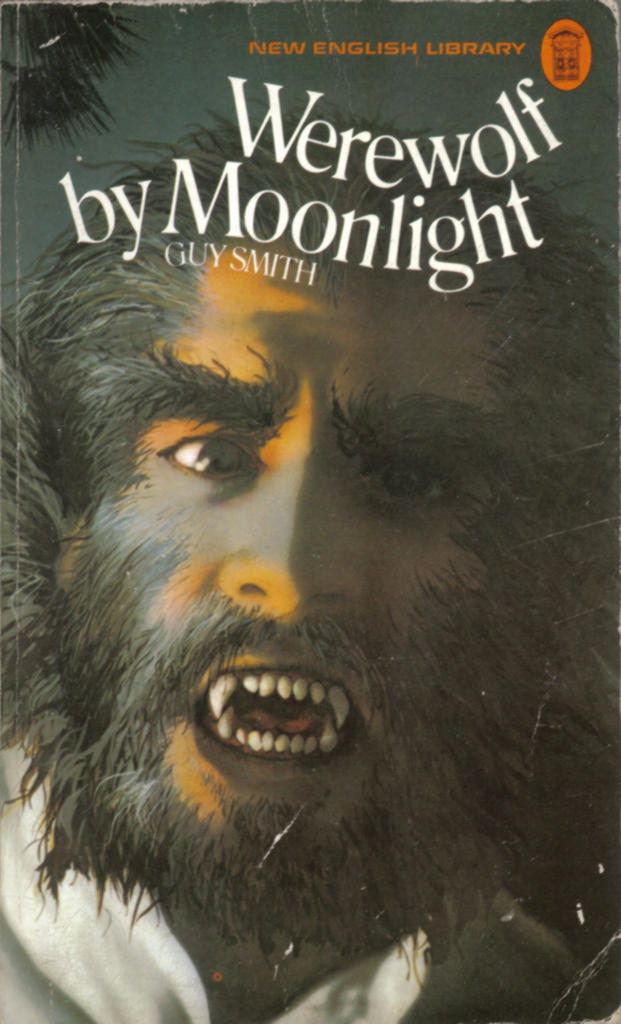
WEREWOLF BY MOONLIGHT by Guy N. Smith (New English Library 1974)

As you've probably come to realize by now, there's little I love more than to sink my teeth into a groovy horror paperback series. They're usually great fun, but sometimes they're unmitigated crap. Somehow, Guy N. Smith's werewolf trilogy manages to be both.

Smith ranks as one of the lowest hacks I've encountered in my reading for this blog. In case you're curious, the distinction for the absolute bottom goes to Michael Avallone. Both authors were appallingly prolific, considering how bad they were. The difference is, I can actually read Smith's books through to the end, and even enjoy them on a certain pulpy level.

Imagine if Paul Naschy shot three episodes of a werewolf television series on the lowest budget he ever had to work with (and I mean ever); whatever's flowing through your stream-of-consciousness right now is probably a fair approximation of my reading experience. The novels are pretty cinematic, but not in an especially good way. Something about the lame dialogue and creaky plots made me picture the werewolves as bad actors with long hair, scraggly beards, cheap vampire fangs, and cheap hairy Halloween gloves. I didn't invoke Naschy's name in vain, however. Just as he always brings a fun, infectious energy to even his bottom-tier werewolf movies, so Smith makes up for a lot of shortcomings with an indefinable something that keeps me smiling and turning pages.

Werewolf by Moonlight opens in the Welsh hills. Gordon Hall is a womanizing journalist who loves to hunt on his country property. He starts an affair with Margaret Gunn, one of the local yokels with an even more stupid and yokelish husband. Meanwhile, on another farm nearby, a young man is bitten by the sheep dog his father bought in Germany's Black Forest. It turns out that the dog was a carrier for lycanthropy, so now Philip Owen is a werewolf. He runs all over the place during full moons, ripping up sheep and whatever else he can find. He usually does find a human or two. When he finds women, he rapes them, then devours them. And he's got an eye for Margaret Gunn. You would think he'd meet his end in the grand finale, when he goes for Margaret at the exact same time her husband confronts his cheating wife and Gordon Hall with a shotgun. Instead, though, the normal humans rally together to chase him out, and then he dies in a way that's so silly I'd hate to spoil it for you here.

For some reason, these books are ridiculously expensive collector's items. If you already have them on your shelves or in your attic, I can recommend them as reads. But I absolutely cannot recommend them as purchases at the prices I've seen.

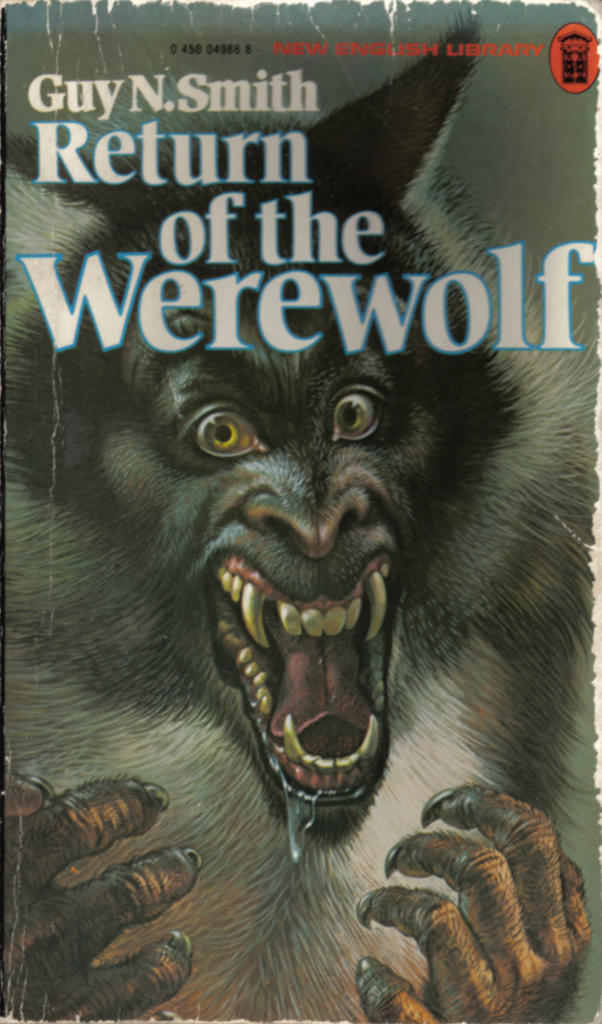
RETURN OF THE WEREWOLF by Guy N. Smith (New English Library 1977)

You know that crappy Friday the 13th, right in the middle of the series, with the Scooby Doo ending--where Jason isn't really Jason, but just some doofus in a mask? Yeah, well, for some reason, Guy Smith decided to stick an episode like that right in the middle of his werewolf trilogy. This installment begins well enough, with what looks like one werewolf digging up the grave of the dead werewolf from the previous novel. That made all the characters (and me) think that maybe two werewolves would be on the rampage. That would have been cool! Why didn't Smith run with it?!? Instead we get no werewolves, since the dead one stays dead (the body is found toward the end), and the one that dug him up was wearing a costume.

There's some subplot about a poacher. The only point of it is for him to dig the pit trap that kills the imposter werewolf. For the record, he actually meant to kill Gordon Hall, the he-man journalist hero who returns to continue his affair with Margaret Gunn.

Speaking of Margaret, remember how the first werewolf wanted a "piece" of her? Well, so does this one. Only this one succeeds. He rapes her. Yep--if tacky, tasteless, and exploitative is what you're in the mood for (and why not, every once in a while?), you could do far worse than read a book by Smith.

At the end of the novel, after the guy is dead, we get a hint that maybe he really was a werewolf just a little bit. Sort of like the sheep dog from the first novel was a carrier of lycanthropy, so this imposter werewolf might possibly be a sort of carrier. Is he or isn't he? I'll spare you the suspense: the final installment is titled Son of the Werewolf.

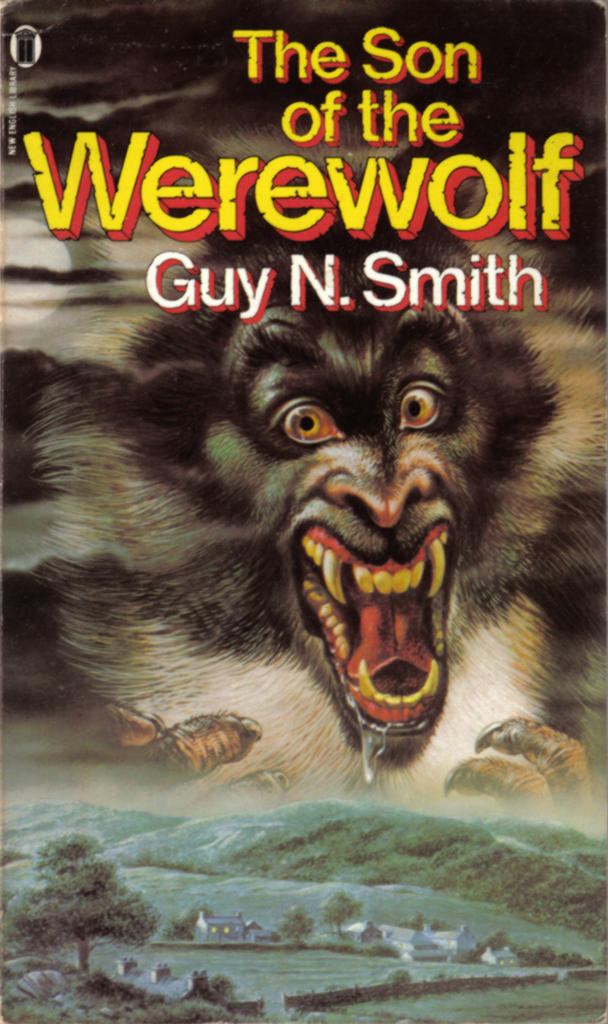
SON OF THE WEREWOLF by Guy N. Smith (New English Library 1978)

It was a dark and stormy night. Actually, the way Smith puts it, "The storm had been the most terrible feature of the nocturnal hours." I kid you not! That is how Son of the Werewolf begins.

The storm coincides with the birth of Margaret's son--the one conceived when the imposter werewolf raped her. Only it turns out he wasn't entirely an imposter. Margaret looks at the baby's fingers as soon as the nurses hand him to her. Sure enough, his third fingers are longer than the rest.

Flash forward, and the boy is in school. He follows a predictable path from bully to murderer to convict to, finally, werewolf. His first transformation actually takes place in his prison cell. He manages to hide it during his years there by getting himself committed to solitary. Flash forward to his release. A regular right-down bad 'un, he roams the countryside, raping, killing, devouring, until he comes to Birmingham. This is the only novel of the trilogy that gives us "werewolf in the city" action.

Eventually, he returns to the Welsh hills where everyone has been dreading his return. All through the series, we've heard local legends about spectral Black Dogs. They're a bad omen, of coure, and considered very dangerous. They begin to bay when the werewolf returns. At the climax of this concluding novel, the Black Dogs finally emerge from some other world, perhaps Hell, to face the werewolf in a night-battle of supernatural creatures. Ah, it's not as cool as it sounds, I'm sorry to say, but it does maintain the pulpiness right through.

Having come to the end of the trilogy, I'll reiterate the point that it's lots of good stoopid fun with generous helpings of sleaze, but there's not enough there to justify the prices these command as collector's items.